Industry & Technology
The State of BESS Operations: Where Teams Lose Time and Revenue
In the 2026 BESS Pros Survey, many operators reported that they have access to BESS data. Yet despite this visibility, day-to-day operations are still slowed by fragmented tools, unclear accountability, and reactive troubleshooting.

March 4, 2026
Share the article
The survey gathered insights from 117 professionals working with battery energy storage systems, revealing the bottlenecks and time sinks that continue to limit performance.
We recently hosted a webinar with ESN to unpack these findings and explore what they mean for daily BESS operations. In this post, we recap the key takeaways from that discussion and what they reveal about the operational reality behind the data.
Key Takeaways
- Suppliers are often rated well, but accountability for resolving problems is the weak link.
- Troubleshooting is time-consuming because data is scattered, and too many parties are involved, making it hard to pinpoint who should fix what.
- LTSAs are common, but they don't replace hands-on ownership. You still need someone on your side to manage performance.
- Having data isn’t the same as using it. Many teams can access data but still struggle to turn it into clear insights and day-to-day actions.
If you work in battery energy storage operations, you have probably felt this firsthand: you can access plenty of data, but when something goes wrong, getting to a clear root cause still takes too long.
That exact tension is one of the findings from our 2026 BESS Pros Survey: data availability does not automatically translate into actionable insights. The survey brings together insights from 117 professionals working hands-on with grid-scale battery energy storage systems.
Read on to find out more about the biggest takeaways for day-to-day operations teams.
Supplier Satisfaction Looks Fine, Until You Ask About Accountability
One of the more interesting signals from the survey discussion was this split:
- Reliability and uptime earn generally positive sentiment.
- Support and maintenance feel less consistently strong.
- Accountability for resolving issues shows noticeably higher dissatisfaction. 25% of respondents are rating it as poor or very poor.

That gap matters because it often shows up when an incident becomes a “multi-party problem.” The team you call might respond quickly and be easy to work with, but resolution can still stall if a fix depends on upstream OEMs, replacement parts, or unclear contractual obligations.
Early in a project’s life, performance buffers can hide problems. If a site is oversized or has reserve margin, you can still meet nameplate expectations while individual components quietly drift out of spec. Over time, those hidden issues become harder to ignore and they tend to become more expensive.
Troubleshooting Is Not an Occasional Task, It Is the Operating Model
If there is one operational pattern that came through clearly, it is that troubleshooting has become the default mode for many teams.

The reason is not hard to recognize: unexpected deratings, alarms, and performance anomalies trigger a familiar loop:
- Something trips or derates
- Teams investigate across tools and datasets
- Multiple stakeholders get involved
- Root cause analysis stretches out
- A fix is implemented and validated
- The issue returns or a new one appears
Even with suppliers and O&M providers engaged, asset owners still spend serious time interpreting alarms, chasing evidence, and pushing resolution forward. The operational cost is obvious. The financial cost is often worse, because troubleshooting time is commonly paired with real revenue impacts when availability or usable energy drops.

This is also where operational KPIs become more than reporting. Metrics like availability, usable energy, and recoverable energy help quantify what is actually lost versus what can be regained through remediation.
LTSAs Are Common, But They Do Not Remove the Need for Active Asset Management
Long-term service agreements show up as a default strategy across the industry, and many owners rely on third-party O&M rather than building fully in-house operations teams. Only 5% of asset owners manage O&M fully in-house.
But the key operational reality is simple: an LTSA can outsource tasks, but it cannot outsource ownership.
Contracts are hard to change after execution. If scope, definitions, or obligations are vague, it is difficult to fix later.
Some agreements can still allow component-level underperformance while meeting higher-level guarantees. If the contract is written around nameplate performance, owners may lack leverage to force remediation for deeper issues until they become severe.
When accountability is spread across that chain, someone on the owner's side usually still needs to coordinate, verify, and push.
Find out why LTSAs may not adequately address day-to-day operational shortcomings in this blog post.
Fragmented Data Is a Force Multiplier for Complexity
A major driver of troubleshooting time is not just technical complexity but rather workflow complexity.
Operational data often lives across:
- EMS outputs
- SCADA-like monitoring tools
- OEM portals
- Quality and commissioning datasets
- Manual spreadsheets for KPI rollups
Even “simple” operational KPIs can require manual effort. When data is scattered, teams lose time in three places: finding the right dataset, reconciling inconsistent timestamps or definitions, building enough component-level evidence to assign responsibility.
The outcome is predictable: longer calendar time to resolution, and more gray area over who owns the fix.
Wondering how a BESS tech stack looks like? This guide helps you understand the technology landscape.
Many Teams Say They Have Data Access, But Still Lack a Single Source of Truth
Operators increasingly report they have data access or ownership. In fact, 70% of respondents say they have long-term access to BESS data, and 20% are working on it. Yet they also report pain points like limited usability, too many dashboards, and no single source of truth.
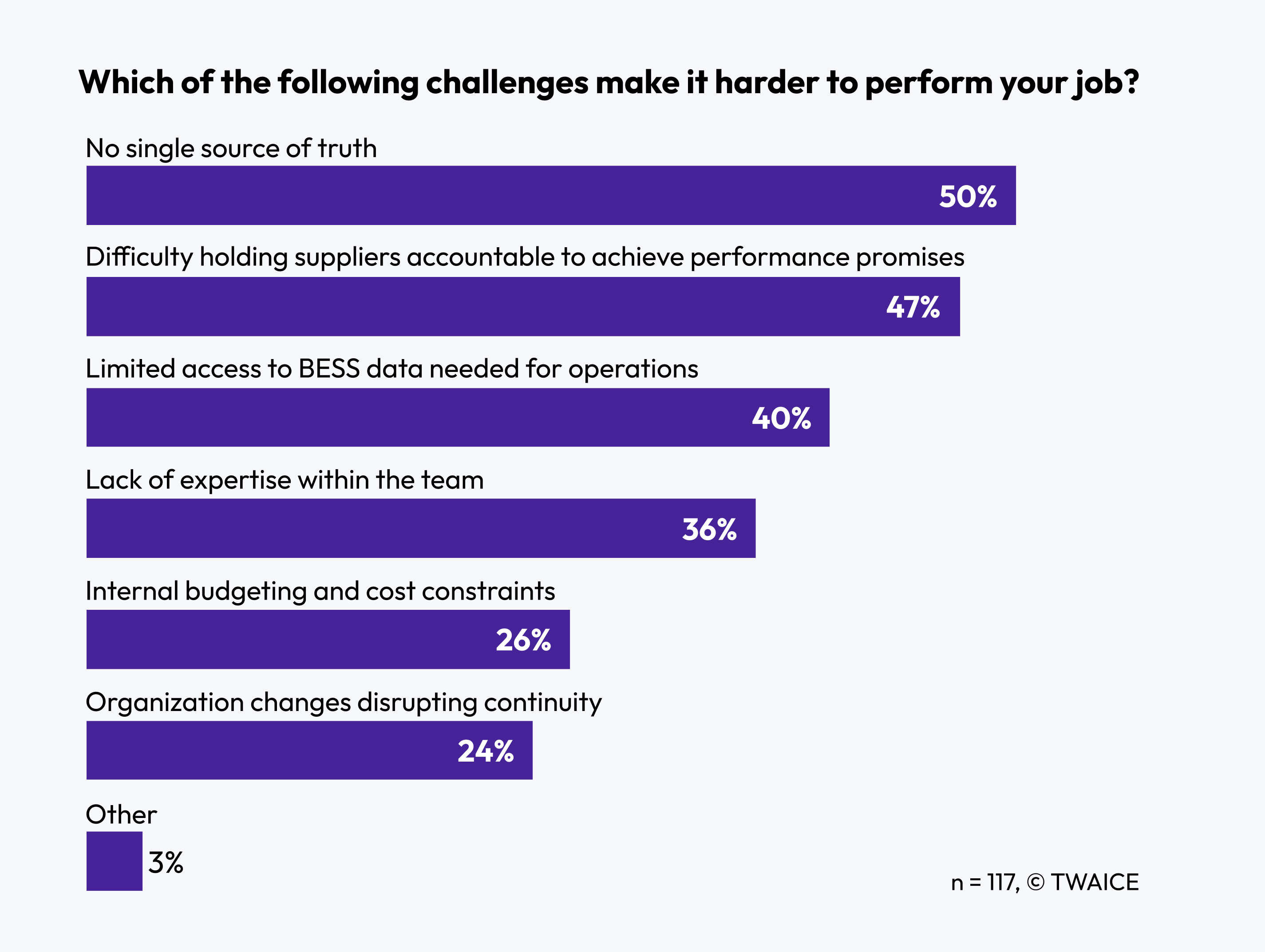
That is not a contradiction. It is a maturity signal.
In many projects, “data access” means you can technically retrieve files or view dashboards. But when problems arise, you discover you do not have the depth, structure, or context needed to answer “why” quickly.
This is why data strategy cannot be an afterthought during project design and contracting.
See how Fullmark Energy, an independent power producer in the US, uses data to its advantage.
Turning BESS data into decisions is now the competitive edge, and the teams that build clear accountability, actionable KPIs, and smarter analytics will spend less time troubleshooting and more time generating revenue.
Find the full webinar here.
Table of contents
Live group demo
See TWAICE Energy Storage Analytics in Action
Sign up for the next live group demo and learn how TWAICE can transform your BESS operations. In just 30 minutes, you’ll get a demo of key features and use cases, and engage with our product experts for a live Q&A.


.avif)