
Industry & Technology
How Grid-Forming Inverters Are Changing BESS Operations
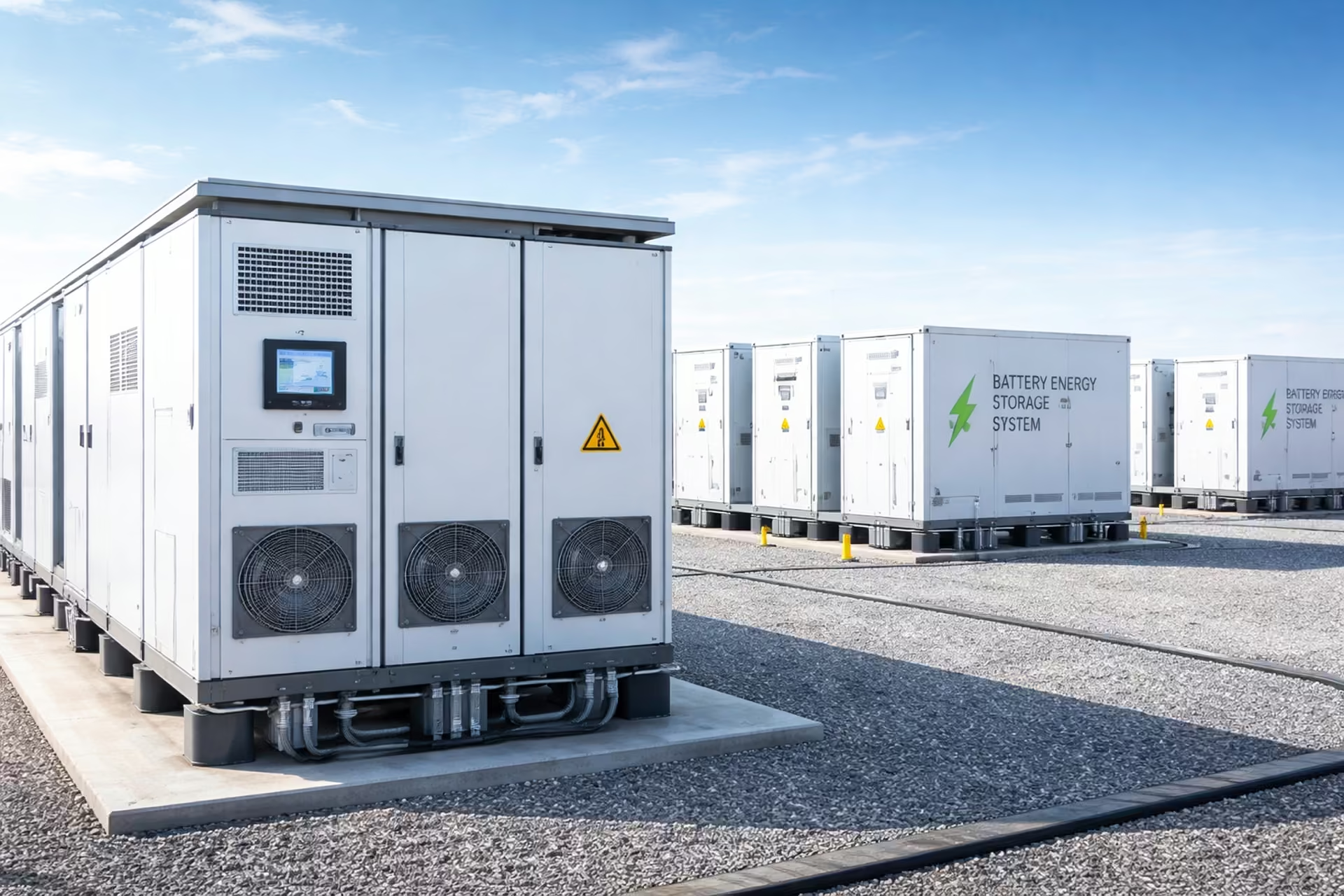
Grid-forming inverters help to stabilize voltage and frequency in the grid. Together with Emil Namor, BESS Performance Analyst at Alpiq, we cover what grid-forming inverters are, why they matter and what operators need to watch out for across acquisition, procurement, commissioning and operation.

March 19, 2026
Share the article
Key Takeaways
- Grid-forming inverters can create and hold a voltage reference and support stable voltage and frequency, which is increasingly valuable in weak-grid or low-inertia conditions.
- For owners and operators, the challenge is not the technology but rather execution since requirements and procurement schemes for grid-forming inverters are still evolving.
- Grid-forming is not “set and forget.” Operators must keep grid-forming capabilities available throughout the BESS lifetime. This includes ensuring correct inverter mode after maintenance operations and making sure the staff understands the expected behavior with the help of training and documentation, so the BESS performs during rare but critical grid events.
Grid-forming (GFM) inverters are quickly becoming a trend BESS teams should pay attention to for one simple reason: the grid is losing the stabilizing effect of synchronous machines. As more inverter-based generation connects and synchronous machines retire, the system’s “built-in” stabilizing behavior declines. In low-inertia conditions, frequency can move faster and more abruptly, which makes rapid stabilizing response more important than it used to be.
GFM inverters establish their own voltage reference and control the waveform of the grid around them. During a frequency drop, a grid-forming BESS can immediately inject active power to counter the deviation, helping stabilize the system before slower resources react. They are built for rapid response to disturbances, supporting frequency and voltage when events escalate quickly.
For BESS operators, this means storage is taking on a new role. BESS are no longer only dispatching energy or providing power; they are also expected to behave like a stability resource, sometimes under tight performance expectations.
The upside is clear: as transmission system operators (TSOs) and markets start procuring stability services such as inertia-like response, grid-forming-capable BESS may be able to access new revenue streams. The risk is just as real: requirements are still evolving, and proving compliance can add scope, testing, and commissioning complexity.
The Basics: Grid-Following vs. Grid-Forming
A good starting point is the difference between grid-following and grid-forming inverters.
Grid-following (GFL) inverters synchronize to an existing grid waveform and then follow it. In other words, they depend on the grid to provide the voltage and frequency reference.
Designed to actively support stable voltage and frequency, grid-forming (GFM) inverters can create and hold a voltage reference. This becomes especially valuable when the grid is weak, when inertia is low, or when conditions change quickly.
A practical way to remember it is this: grid-following listens first, grid-forming leads first.
What BESS Owners and Operators Need to Understand
Grid-forming capability is not “just a PCS feature.” It changes how projects are developed, specified, tested, commissioned, and operated, and it is arriving while requirements are still evolving. Emil Namor from Alpiq shares his learnings from commissioning the first grid-forming BESS in Finland.
Project Acquisition: The Opportunity Is Real, But the Rules Are Moving
From an owner and operator perspective, the first real-world challenge is the evolving regulatory and procurement landscape. Europe does not yet have a single, consolidated approach to integrate grid-forming technologies, even though the need is widely recognized.
Finland has published requirements that frame grid-forming capability as necessary in certain contexts for BESS connections, for example. In the UK, Stability Path finder has been a key procurement route for stability services, including inertia-related needs, with tenders running since the early rounds around 2019–2020. And in Germany, TSOs have launched an inertia procurement scheme with defined procurement periods beginning in early 2026, and grid-forming resources are part of the broader conversation around providing these services.
That creates a mix of upside and uncertainty. On the one hand, new requirements and market-based procurement schemes can open additional revenue streams, including inertia or stability services delivered by grid-forming capable BESS. On the other hand, project acquisition decisions are based on revenue projections years in advance, and uncertainty around requirements and remuneration can make investment cases harder to bank.
What to do with this as an operator: treat stability revenues as an opportunity, but be conservative in your base case unless the prequalification path, testing scope, and eligibility rules are fully confirmed.
Project Procurement: Clarify Scope Early, Because Labels Can Mislead
Technically, much of the novelty in grid-forming lies in control software, and many major suppliers can provide grid-forming options today. But procurement risk shows up when teams rely on umbrella terms instead of pinning down what is actually required and testable.
A common example is grid-forming vs. black start.
Both are often mentioned together, but they are not the same thing. A grid-forming inverter can establish a voltage reference and support stability behavior. Black start (the ability to restart parts of the grid after a blackout without external power), however, requires additional hardware and software. Having grid-forming inverters does not mean having a black-start capable BESS.
This is where small misunderstandings can get expensive. If a missing capability is discovered late, fixes can become change orders, or worse; they can force redesigns or commissioning delays.
What works in practice: write requirements as testable performance criteria, align early with the TSO’s documentation and modeling expectations, and make sure EPC, PCS, and simulation partners share the same interpretation before procurement locks.
Project Construction and Commissioning: Plan for New Proof Points
Even if the hardware is ready, project execution often becomes a real bottleneck. Grid-forming capability typically needs to be confirmed with technical documentation and simulations during execution and then validated through dedicated commissioning tests with the TSO.
On paper, that is not fundamentally different from other grid-code compliance work. In reality, grid-forming adds schedule risk because requirements are newer and less standardized. Interpretations may change, and “first-of-kind” tests can require extra alignment across the supplier, EPC, and the TSO.
As Emil from Alpiq put it: “Today, all new BESS to be connected in Finland are expected to have grid-forming capability. We had the honor and the burden of being the first to commission a BESS under this new requirement set. Thanks to a great collaboration with the project developer and EPC contractor (Merus Power) and the Finnish national TSO (Fingrid), we were able to successfully carry out the required simulations and test and deliver the project at the target COD. We needed some additional coordination and effort. The required simulations were "a first" for all stakeholders. We had to make sure that all parties involved had the same understanding down to the details of what was required. Only one missed requirement or unsatisfactory simulation could have pushed the COD by weeks, if not months.”
BESS projects are complex. Early mistakes can have a lasting impact. This guide helps you think ahead with helpful insights, checklists, and resources.
What “Good Operations” Looks Like for a Grid-Forming BESS: Keep It Ready
Because a BESS can still participate in the usual energy and ancillary service markets in either grid-following or grid-forming mode, it is easy to treat grid-forming as a commissioning task: set the right parameters and never look at them again. That approach is risky.
A grid-forming capability does not visibly change daily BESS behavior, but it becomes critical when the grid is stressed, for example after a major disturbance or outage. Those events are infrequent and unpredictable, which is exactly why operators need confidence that the capability will be available and respond when it matters most.
In practice, good operation ensures that grid-forming capability remains available, correctly configured, and visible at all times. After maintenance or any PCS shutdown, verify the system returns in the intended mode, confirm it cannot silently switch to another mode, and ensure the control mode is observable in SCADA or monitoring.
Finally, plan for the fact that a major grid disturbance may come years later. The grid operator will then steer the restoration operation. The BESS will be expected to support it based on its grid-forming characteristics. That requires trained personnel who understand the BESS’s grid-forming capabilities and expected behavior. As teams change, it is essential to preserve operational knowledge and maintain clear documentation.
The goal is simple: do not only meet grid-forming requirements at commissioning, keep meeting them for the full lifetime of the project.
Table of contents
Live group demo
See TWAICE Energy Storage Analytics in Action
Sign up for the next live group demo and learn how TWAICE can transform your BESS operations. In just 30 minutes, you’ll get a demo of key features and use cases, and engage with our product experts for a live Q&A.


Abouth the Author
Emil Namor
Emil Namor is BESS Performance Analyst at Alpiq. Since 2015 he works on lithium-ion battery diagnostics across research, automotive, and energy sectors. His work with grid-forming technologies started in 2018 within the H2020 project Osmose. Today, he monitors the evolution of this technology and its impact on power systems and represents Alpiq in the Inertia and Grid Forming task force of the Energy Storage Europe association.
Connect on Linkedin